11 July 2026
AI customer service: what actually works (and what doesn't)
Answering the same questions every day? Forgotten passwords, where’s my refund, how does feature X work. For most support teams, the bulk of the work comes from a small set of recurring topics. That’s exactly where AI customer service delivers the most value. But the order in which you build it decides whether it works.
What do we mean by AI customer service?
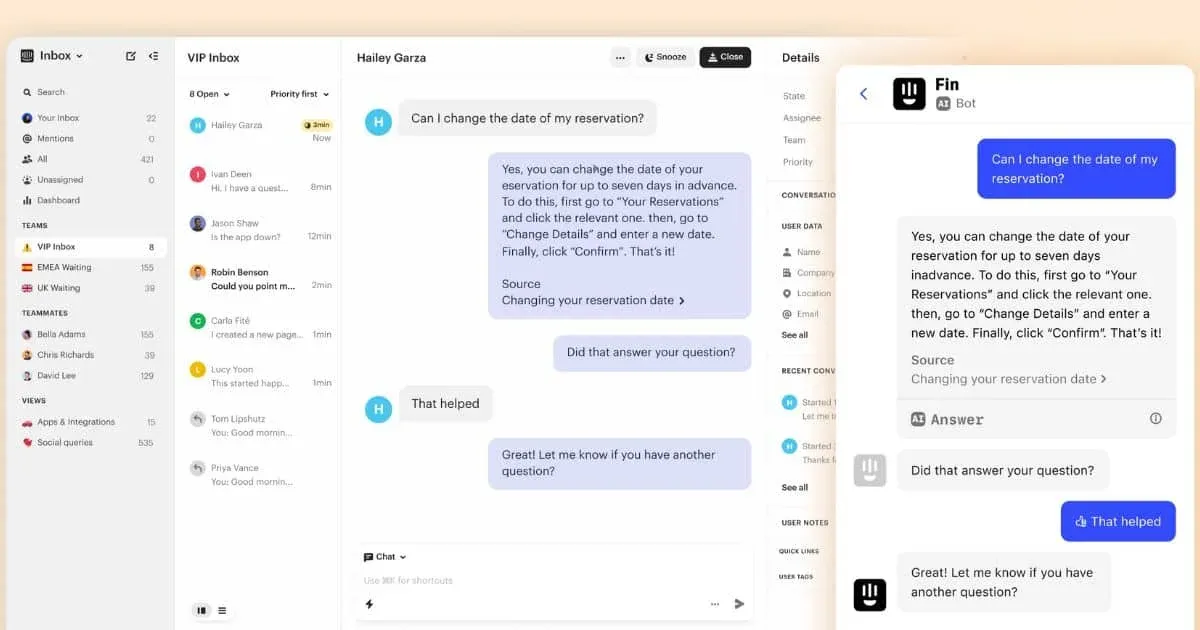
An AI agent that resolves customer questions fully and on its own, from your knowledge base and your customer data. That’s something else than the chatbot of ten years ago with a decision tree and canned answers. A modern AI agent such as Intercom’s Fin AI understands the question, finds the answer in your own documentation and hands over to a human the moment that’s needed.
Why many AI projects in support disappoint
The temptation is to switch on an AI chatbot right away. The result is usually underwhelming. An AI sitting on top of a messy process gives messy answers at scale. If customer context is missing, the customer still has to explain everything themselves. If the knowledge base is outdated, the AI gives outdated answers.
Our rule: AI only adds value once the underlying process is sound.
Integrating AI into your customer service: three steps
1. Map your questions
Start by measuring. Which questions come in, through which channels, and how often? Who handles them and where do things stall? Almost every support team shows the same picture: a long tail of unique questions and a small core of recurring topics such as account issues, payments and simple technical questions. That core is your automation candidate.
2. Automate the information gathering
This is where the biggest win sits, before any AI is involved. Take a refund request. Without a workflow, an agent sends three or four messages to collect the transaction number, the reason and proof of payment. With a workflow in a platform like Intercom, the system asks for all of it by itself, and your team receives a complete file.
The same goes for technical issues. Have the customer run through a few troubleshooting steps first, such as clearing cookies or attaching a screenshot. Only what remains after that goes to a human.
3. Then the AI agent
Once the process is in place, an AI agent such as Fin AI can do the real work: resolving questions entirely on its own from your knowledge base. Two things decide the outcome:
- A current knowledge base with an owner. New policies and product changes need to land in the knowledge base right away. Better still: sync your product documentation automatically.
- A feedback loop. Review weekly which questions the AI missed or got wrong, and fill the gaps. The system gets better every week.
Want to know what’s automatable in your support process? Request a free process analysis.
What can an AI chatbot for customer service do, and what can’t it?
Where an AI chatbot is strong:
- Resolving recurring questions entirely on its own, from password resets to questions about your policies.
- Collecting information before a human takes over the conversation.
- Responding instantly, day and night, in every language your customers speak.
Where an AI chatbot is weak:
- Exceptions and edge cases with no policy to lean on.
- Conversations that mostly need empathy, such as an angry customer or a sensitive complaint.
- Questions whose answer isn’t documented anywhere.
Accept those limits and get the handover to a human right, and the chatbot strengthens your team instead of frustrating your customers.
Which AI customer service software is out there?
Every major support platform now ships an AI agent: Intercom has Fin AI, Zendesk and Freshdesk have their own variants, and Trengo offers AI features too. We work mostly with Intercom and are an Intercom Certified Partner. The reason: Fin answers from your own knowledge base, the platform combines inbox, workflows and AI in one system, and it connects to your own backend through the API.
More important than the tool: the three steps above. The best software changes little if your process doesn’t work.
AI customer service on WhatsApp
Many customers prefer to ask their question on WhatsApp. Connect WhatsApp Business to your support platform and your AI agent works exactly the same there: the same knowledge base, the same workflows, the same handover to a human. One knowledge base serving all your channels keeps your answers from drifting apart per channel.
What’s a realistic result?
At a fast-growing marketplace we built this up step by step: first the migration to Intercom, then workflows, then Fin AI. Today around 70% of all support questions are handled fully automatically. Read the full case: from scattered support to scalable customer service with Fin AI.
Just as important as the percentage: the work that remains is the work humans are good at. Complex cases, sensitive situations, exceptions. Not resetting the same password a hundred times a week.
Ready to start?
Thinking about AI for your customer service? We design and build these systems, from process analysis to AI implementation. Request a free process analysis, or first read how to approach a Trengo to Intercom migration.
Quick question · 30 seconds